The Beacon Blog
Civil Engineer Career Path: A Year-by-Year Plan From FE to PE
A civil engineer career path from the FE exam to the PE license, laid out year by year, with the pay assumptions behind each step shown.

You want to sign your own drawings, lead projects and earn more each year, and you know the PE license sits in the middle of that. The civil engineer career path from graduate to licensed engineer takes years, and it's easy to drift through them: a busy site, a deadline, another year gone without booking the exam. This post lays the path out year by year, shows the assumptions behind every pay figure, and explains how to turn it into a weekly plan you actually keep.
The licensure path, in plain words
The most common route to the Professional Engineer license in the U.S. has four parts. Licensing boards generally require a bachelor's degree from an accredited program, most states require four years of acceptable, progressive and verifiable work experience, and candidates typically must pass two exams, the FE and the PE (NCEES, Licensure).
Requirements vary. Many states offer other paths, and NCEES advises checking the rules of the state where you plan to practice before you plan around them.
The first exam, Fundamentals of Engineering, is a computer-based exam given year-round at approved test centers, and it's designed for recent graduates and students close to finishing an accredited degree (NCEES, FE exam). That makes it the natural first step: the material is fresh, and passing it early keeps the rest of the path open. The PE exam comes after the experience years. You register and schedule it through your MyNCEES account (NCEES, PE exam).
That's the use barrier for planning tools: the job isn't "use AI for my career." It's "tell me what to do this year so I'm ready for the PE when I'm eligible, and what that does for my pay."
A worked example, with every assumption shown
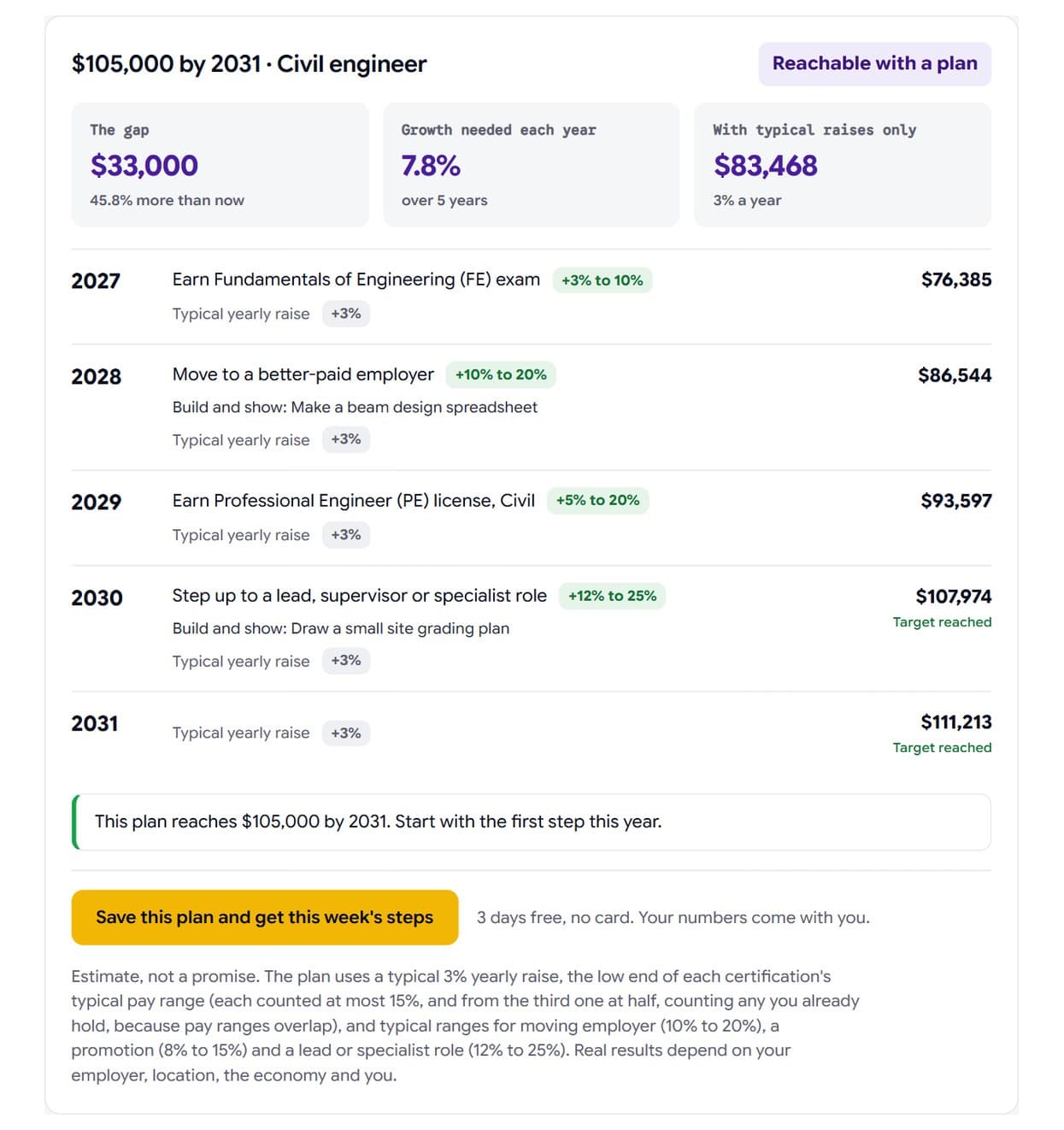
Here's what Beacon's Ambition Planner produces for one example, run in 2026. A civil engineer in the United States, one year out of school, earning 72,000 dollars a year, aiming for 95,000 by the end of 2030. These are example inputs, not a typical salary.
- 2027: earn the FE, plus a typical yearly raise.
- 2028: move to a better-paid employer, and build and show a beam design spreadsheet as a project to back the move.
- 2029: a typical yearly raise.
- 2030: earn the PE license, Civil, and the plan reaches the target.
The planner calls this "Reachable with a plan." It shows a gap of 23,000 dollars, about 7.2 percent growth needed each year, and that typical raises alone would reach about 81,000 by 2030. You can run this exact example on the planner and change any number.
The figures come from stated assumptions, printed under every plan: a typical 3 percent yearly raise; 10 to 20 percent for moving employer; 8 to 15 percent for a promotion; and the low end of each certification's typical pay range, capped at 15 percent each, with the third certification onward counted at half because pay ranges overlap. The planner uses the low end, so it errs on the careful side (see the assumptions on the planner). It's an estimate, not a promise. Real results depend on your employer, location, the economy and you.
Notice the order. Early in a career, the planner puts the licensure track first, FE then PE, ahead of optional credentials. Once you have five or more years of experience, it orders certifications by their careful pay effect instead. If you already hold the FE, you tick it and the plan leaves it out; ticking the PE leaves out the FE too, since the higher license needs it.
Skills that make the experience years count
The four experience years aren't a waiting room. The capability barrier is knowing what to build in them. Beacon's skills gap for civil engineers lists what people usually hold at each level:
- Core: beams, loads and structural basics; Civil 3D or similar design software; design codes and standards.
- Next: soil mechanics; reinforced concrete design; site supervision and inspection, since field experience helps on the way to licensure.
- Lead: cost estimates and schedules; client and contractor management.
You mark what you have, and it names the next three gaps to close. Projects turn those skills into proof you can show in a review or an interview: a beam design spreadsheet checked against a textbook example, a small site grading plan with rough cut and fill quantities, or a written review of a local road, bridge or drainage project. If you use AI to help build that spreadsheet, the verification habits in AI tools for engineers and analysts apply: check it against a case you already know.
Beyond the license, the certifications list for a U.S. civil engineer also includes optional credentials such as LEED AP and the Project Management Professional, each with its typical duration and a link to the body that runs it. Pick one that fits the role you want next, not every one on the list.
From a yearly plan to this week's steps
Most licensure plans fail on consistency, not difficulty. The FE gets pushed back a quarter at a time, and then it's been three years.
Beacon breaks the first year of your plan into small steps for each of the next twelve weeks. For a certification, those steps are concrete: check what the exam needs, book a date eight to ten weeks out, three study blocks, then a full practice test. You tick steps off, keep a streak, and can add them to your calendar. A Monday email brings this week's steps and what's new for your role, so the plan comes back to you instead of waiting to be remembered.
When the review comes, the Briefs module builds a one-page raise case or interview prep from your own plan and finished work, ready to print.
For a broader learning plan that works across roles, see our 12-month AI upskilling plan. If you're in a trade rather than engineering, read Will AI replace electricians? for how to think about the next step there.
Your next step
Check your state board's requirements, then write down three things: the pay you want, the year, and when you'll sit the FE if you haven't yet. Open the Ambition Planner, choose Civil engineer and enter your own numbers; no account is needed and nothing you type is saved. When you want those steps each week, start with Beacon. This is Applied Intelligence for a career: a plan built around your goal, with the follow-up that keeps it going.
Frequently asked questions
How do you get a PE license as a civil engineer?
The most common U.S. route has four parts: a bachelor's degree from an accredited program, passing the FE exam, four years of acceptable, progressive and verifiable work experience in most states, and passing the PE exam. Requirements vary, and many states offer other paths, so check your state board's rules before you plan around them.
When should I take the FE exam?
Early, while the material is fresh. The FE exam is designed for recent graduates and students close to finishing an accredited degree, and it's given year-round as a computer-based exam at approved test centers. Passing it early keeps the rest of the path to the PE license open while you build your experience years.
How long does it take to go from the FE to the PE?
On the most common route, the PE exam comes after the four years of work experience most states require. In the worked example in this guide, an engineer one year out of school earns the FE in 2027 and the PE license in 2030. Your state board's rules set your own timeline, so check them first.
How much does a PE license raise a civil engineer's salary?
It depends on your employer, location, the economy and you, so treat any figure as an estimate. Beacon's Ambition Planner counts the low end of each credential's typical pay range and prints that assumption under every plan, so it errs on the careful side. Enter your own pay and target to see your route.


